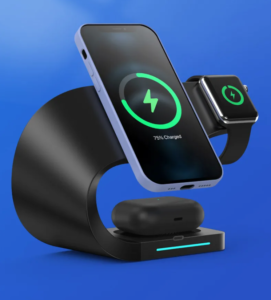
The era of tangled cables and hunting for the right charger is rapidly coming to an end. Wireless charging technology, once a futuristic concept relegated to science fiction, has evolved into a mainstream solution that’s transforming how we power our devices. From smartphones to electric vehicles, wireless charging is experiencing unprecedented growth and innovation, creating a seamless, cable-free future that’s finally within reach.
Market Explosion: Numbers That Tell a Story
The wireless charging market is experiencing explosive growth that reflects consumer demand for convenience and technological advancement. Current market projections show remarkable momentum, with the global wireless charging market expected to reach $14.8 billion in 2025, climbing to $28.4 billion by 2028. This represents a staggering compound annual growth rate (CAGR) of 24.4% through 2032, indicating that wireless charging isn’t just a trend—it’s becoming an essential technology infrastructure.
North America alone demonstrates the technology’s rapid adoption, with the market valued at $5.86 billion in 2024 and projected to reach $17.75 billion by 2033. This growth trajectory reflects increasing consumer acceptance and the proliferation of wireless charging-enabled devices across multiple industries.
Core Technologies Driving Innovation
At the heart of wireless charging lie several sophisticated technologies that enable efficient power transfer without physical connections. Inductive charging currently dominates the market, utilizing electromagnetic induction to transfer energy between a charging pad and a receiver coil. This technology, which held the largest market share in 2024, works by creating an electromagnetic field that transfers energy across small distances.
Magnetic resonance technology represents the next evolution, offering greater flexibility in device positioning and the ability to charge multiple devices simultaneously. Unlike inductive charging, which requires precise alignment, magnetic resonance allows for more forgiving placement and can even charge devices through various materials and surfaces.
These technologies are becoming increasingly sophisticated, with manufacturers developing solutions that can deliver faster charging speeds while maintaining efficiency. The latest wireless chargers can now deliver power comparable to traditional wired solutions, eliminating one of the primary barriers to adoption.
Revolutionary Applications Beyond Smartphones
While smartphones, smartwatches, and electric toothbrushes currently represent the top three applications driving market growth, wireless charging technology is expanding into revolutionary new territories. The most transformative application emerging is wireless electric vehicle (EV) charging, which promises to eliminate range anxiety and charging infrastructure limitations.
Wireless EV charging utilizes magnetic resonance and inductive coupling technologies to enable efficient power transfer between charging pads embedded in the ground and receivers mounted on vehicle underbodies. This seamless approach allows vehicles to charge while parked or even while driving over specially equipped road surfaces, creating possibilities for continuous power delivery during travel.
Smart homes are integrating wireless charging surfaces into furniture, countertops, and even walls, creating charging zones throughout living spaces. This integration represents a fundamental shift toward invisible, omnipresent power delivery that eliminates the need for dedicated charging stations and cables.
Industrial applications are also emerging, with wireless charging systems being deployed for powering sensors, IoT devices, and autonomous robots in manufacturing environments. These applications leverage the technology’s ability to provide reliable power in harsh conditions where traditional charging methods would be impractical.
Technological Breakthroughs Shaping the Future
Recent technological advances are addressing historical limitations while opening new possibilities. Fast wireless charging has made significant strides, with some systems now delivering power levels that rival or exceed traditional wired charging speeds. Advanced thermal management systems prevent overheating during high-power transfers, ensuring device safety and longevity.
Efficiency improvements have been dramatic, with modern wireless charging systems achieving energy transfer rates above 90%. This efficiency gain addresses environmental concerns while reducing energy waste, making wireless charging a more sustainable power delivery method.
Multi-device charging platforms represent another breakthrough, allowing single charging stations to power multiple devices simultaneously with intelligent power allocation. These systems can detect device requirements and automatically adjust power delivery for optimal charging speeds across all connected devices.
Long-range wireless charging is emerging from research laboratories, with companies developing systems capable of transmitting power across several meters. While still in early stages, this technology could enable truly wireless environments where devices charge simply by being in proximity to power transmitters.
Overcoming Traditional Limitations
The wireless charging industry has systematically addressed early limitations that hindered adoption. Charging speed, once a significant drawback, has improved dramatically with new protocols delivering rapid charging capabilities. Device compatibility has expanded through standardization efforts, with the Qi wireless charging standard gaining widespread adoption across manufacturers.
Positioning sensitivity, which previously required precise device placement, has been reduced through larger charging surfaces and improved coil designs. Modern wireless chargers feature multiple charging zones and can accommodate various device sizes and orientations.
Cost barriers are diminishing as manufacturing scales increase and component prices decrease. Wireless charging capabilities are now standard features in mid-range devices, not just premium products, accelerating mass market adoption.
Environmental and User Experience Benefits
Wireless charging offers significant environmental advantages by reducing cable wear and replacement needs. The elimination of physical connectors reduces device port damage and extends product lifecycles. Additionally, standardized wireless charging reduces electronic waste by minimizing the need for device-specific charging accessories.
The user experience improvements are equally compelling. Wireless charging eliminates the frustration of damaged cables, incompatible connectors, and wear on device ports. The convenience of simply placing a device on a charging surface creates a more intuitive, user-friendly charging experience that fits seamlessly into daily routines.
Industry Leaders and Market Dynamics
Major technology companies are driving innovation through substantial research and development investments. Samsung Electronics, Sony Corporation, Qualcomm Incorporated, and Texas Instruments lead market development with breakthrough technologies and strategic partnerships. These companies are not just improving existing solutions but pioneering entirely new applications and use cases.
The Asia Pacific region currently dominates the wireless charging market, representing the largest market share due to high smartphone adoption rates and manufacturing concentration. However, North American and European markets are experiencing rapid growth driven by electric vehicle adoption and smart home integration trends.
Future Outlook: A Wireless World
The future of wireless charging extends far beyond current applications. Integration into public infrastructure will create charging opportunities in restaurants, airports, vehicles, and public spaces. Smart cities are beginning to incorporate wireless charging into street furniture, parking spaces, and transportation systems.
Automotive integration represents the most transformative opportunity, with major manufacturers developing vehicles equipped with wireless charging capabilities. This technology could revolutionize transportation by enabling continuous charging during travel, effectively eliminating range limitations for electric vehicles.
The convergence of wireless charging with other emerging technologies like IoT, 5G networks, and autonomous systems will create intelligent power ecosystems that anticipate and respond to device needs automatically.
As wireless charging technology continues evolving, we’re approaching a future where power delivery becomes invisible, ubiquitous, and seamless. The substantial market growth, technological breakthroughs, and expanding applications demonstrate that wireless charging isn’t just changing how we power our devices—it’s fundamentally transforming our relationship with energy itself. The cable-free future is no longer a distant vision; it’s arriving faster than ever anticipated, promising unprecedented convenience and possibilities for how we interact with technology in our daily lives.